🏗️ Master the Art of Embedded Software Design
Transition from “Code that Works” to “Code that Scales”
In the world of embedded systems, writing code is easy, but designing a system that is portable, maintainable, and robust is a challenge. My learning resources are designed to teach you the architectural patterns used by professional firmware engineers in the industry.
🎓 Featured Course: Embedded C Architecture
The Four-Layer Methodology
This comprehensive course breaks down the complexities of firmware development into a logical, four-layer hierarchy. This approach allows you to swap microcontrollers without rewriting your entire application.
- HAL (Hardware Abstraction): Master the silicon-specific register logic.
- Device Layer: Learn to write drivers for external sensors and displays.
- Interface Layer: Create the “contracts” that decouple hardware from logic.
- Application Layer: Develop pure, portable C logic for your system’s “brains.”
🛠️ What You Will Learn
- Portability: How to move code from an STM32 to an ESP32 or AVR with minimal effort.
- Modular Design: Using pointers and structures to create clean, reusable driver modules.
- Professional Workflow: Integrating GitHub and documentation into your engineering process.
🚀 Get Started Today
Ready to elevate your engineering skills? Access the full course, project source code, and community discussions via the link below.
📂 Open Source Resources
Education shouldn’t end with a video. Check out my public GitHub repositories to see the four-layer architecture in action, including real-world projects and template libraries.
Why Choose a Layered Approach?
| Feature | Legacy “Spaghetti” Code | Layered Architecture |
| Portability | Low (Chip-dependent) | High (Hardware Agnostic) |
| Testing | Difficult | Easy (Mocking Layers) |
| Maintenance | High Effort | Low Effort |
| Teamwork | Hard to parallelize | Modular (Divide & Conquer) |
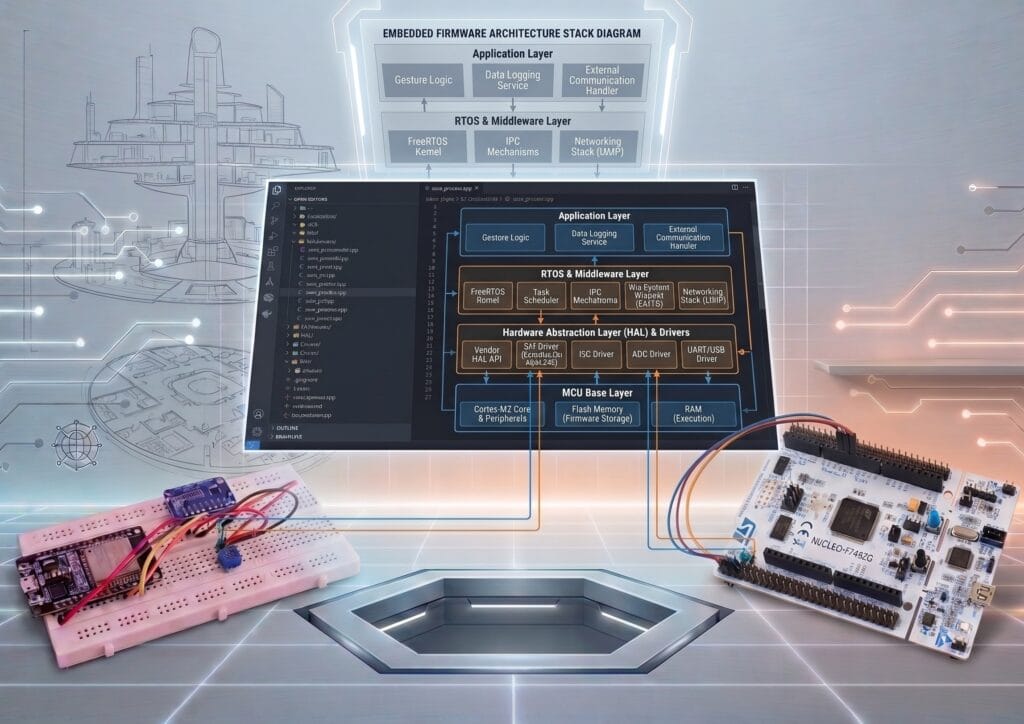
Firmware Architecture & Hardware Integration
This uncut lecture provides a deep dive into professional firmware architecture by walking through the complete development of a custom GPIO Hardware Abstraction Layer (HAL) module. By transitioning from direct register manipulation to a structured, modular software interface on the ESP32, you will learn how to decouple hardware-specific logic from your application code for improved portability and maintainability. This transparent, step-by-step implementation showcases the essential design patterns used to build robust drivers, offering a raw and practical look at how industry-grade firmware is engineered from the ground up.